
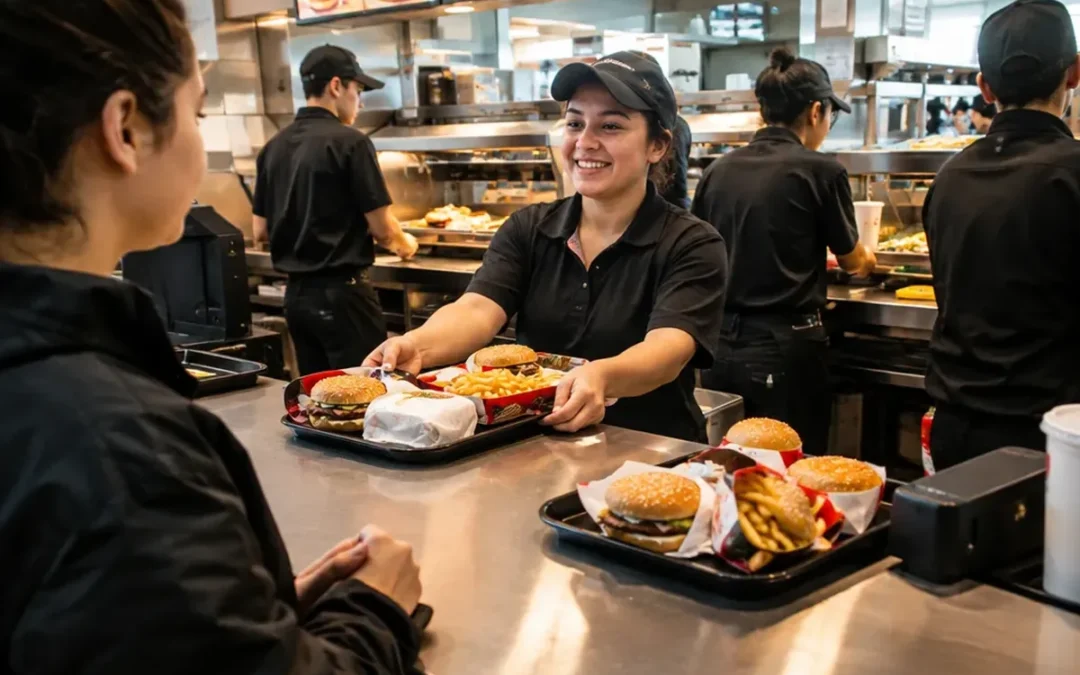
The biggest fast food chain in the world depends on the yardstick. By store count, China’s Mixue Ice Cream & Tea has moved ahead of the brands most Americans expect to see at the top. By sales, McDonald’s remains in a different league. Put those two rankings side by side and the global restaurant business looks far less burger-centered than its U.S. image suggests.
The biggest fast food chain in the world depends on what you measure
By 2024, Mixue led the world by locations with more than 45,000 outlets and reached 59,823 by the end of 2025. At the end of 2025, McDonald’s reported 45,356 locations, while Starbucks had 40,199 at the end of fiscal 2024. Those totals make Mixue the location leader, but they do not make it the sales leader.
McDonald’s generated more than $130 billion in global systemwide sales in 2024. That figure measures sales across the restaurants using the brand, not simply money booked by the parent company. Starbucks, by contrast, reported $36.2 billion in consolidated net revenue for fiscal 2024. Comparing a systemwide-sales total with company revenue without labeling the difference is one of the easiest ways to get this ranking wrong.
The top five food chains by worldwide locations
The table uses the latest location figure supplied for each brand. The reporting years range from 2022 to 2024, so it is a useful scale comparison rather than a single same-day census.
| Rank | Chain | Locations | Reported year |
|---|---|---|---|
| 1 | Mixue Ice Cream & Tea | 45,000+ | 2024 |
| 2 | McDonald’s | 41,822 | 2023 |
| 3 | Starbucks | 40,199 | 2024 |
| 4 | Subway | 37,000 | 2022 |
| 5 | KFC | 30,000+ | End of 2024 |
By the end of 2025, Mixue had reached 59,823 locations, while McDonald’s reported 45,356 locations worldwide, illustrating the rapid expansion of the Chinese brand.
How Mixue became the location leader nobody expected
Mixue began in Zhengzhou, China, in June 1997, when student Zhang Hongchao borrowed 3,000 yuan from his grandmother. Its first two stores failed, and the first successful shop arrived only in 2003 after six moves. A 1-yuan soft-serve product introduced in 2005 or 2006 gave the company a low-price proposition that could travel through a franchise network.
Almost all Mixue locations are franchised, while the company earns much of its income by selling ingredients, equipment, and packaging to franchisees. Its average item price is about 6 yuan, or roughly $0.82. The brand operates in China and 11 other countries, including Singapore, Thailand, Australia, South Korea, and Japan.
Scale did not translate into the same sales result as McDonald’s. Mixue reported 24.8 billion CNY in 2024 revenue, about $3.4 billion, and 33.56 billion CNY in 2025, about $4.95 billion. Its location count and low ticket size explain why a store ranking and a revenue ranking tell different stories.
McDonald’s wins the sales race, not the store-count race
McDonald’s started in San Bernardino, California, on May 15, 1940, as Richard and Maurice McDonald’s barbecue restaurant with carhop service. In 1948, the brothers switched to the Speedee Service System: self-service, a nine-item menu, and 15-cent hamburgers. That stripped-down operating model helped turn a local restaurant into a global chain.
Ray Kroc visited in 1954 as a Multimixer salesman, became a franchise agent, and opened his first McDonald’s in Des Plaines, Illinois, on April 15, 1955. The company bought the brothers’ rights for $2.7 million in 1961. By the end of 2025, it had 45,356 restaurants worldwide, including 13,706 in the United States.
About 95% of McDonald’s restaurants are run by independent franchisees. The business also had nearly 29,000 drive-through locations worldwide; more than 95% of its roughly 13,700 U.S. restaurants had drive-through service. More than $130 billion in 2024 global systemwide sales makes McDonald’s the clear leader by that measure.
Starbucks, KFC, and Domino’s show that burgers are not the whole market
Starbucks opened at Seattle’s Pike Place Market in 1971, funded by three founders who each invested $1,350 plus a $5,000 bank loan. It closed fiscal 2024 with about 40,199 locations and $36.2 billion in consolidated net revenue. More than half of its stores are company-owned, a notably different model from heavily franchised restaurant chains.
KFC traces its story to Harland Sanders, who began serving chicken at a roadside motel in Corbin, Kentucky, in 1930. Its first franchise opened in Salt Lake City in 1952. KFC passed 30,000 locations at the end of 2024 after opening nearly 2,900 restaurants that year, and its 2025 systemwide sales reached $36.4 billion across 33,897 restaurants.
Domino’s began when Tom and James Monaghan bought DomiNick’s in Ypsilanti, Michigan, in 1960; Tom borrowed $900 for the purchase. The company had more than 22,100 locations in over 90 markets on December 28, 2025, and reported $20.1 billion in global retail sales for 2025. It also held about 23.3% of the U.S. pizza QSR market in 2025.
Is McDonald’s or Subway bigger? The answer changes in the United States
Worldwide, McDonald’s was larger than Subway in the comparable supplied figures: 41,822 locations at the end of 2023 versus Subway’s roughly 37,000 in 2022. McDonald’s 2024 global systemwide sales of more than $130 billion also dwarf Subway’s estimated roughly $16 billion systemwide sales in 2020.
In the United States, Subway still had the larger store count: 19,502 locations at the end of 2024, compared with McDonald’s 13,559 in the supplied U.S. comparison. That lead came after a major contraction. Subway fell from more than 27,000 U.S. locations in 2015, a net loss of roughly 7,600 stores.
Subway’s origin was also unusually modest. Seventeen-year-old Fred DeLuca and Dr. Peter Buck opened Pete’s Super Submarines in Bridgeport, Connecticut, in August 1965 with a $1,000 investment. The first store sold 312 sandwiches on day one at prices from 49 to 69 cents. Roark Capital acquired Subway for $9.6 billion in 2024.
Sales, revenue, and restaurant count are three different scoreboards
McDonald’s topped the 2024 U.S. systemwide-sales ranking with about $53.5 billion. Burger King recorded $27.7 billion in global systemwide sales in 2024, Taco Bell had $16.2 billion in U.S. systemwide sales from 7,604 locations, and Domino’s had $20.1 billion in 2025 global retail sales. Each number describes a different business scope, so a clean ranking must retain its label.
Store productivity can be just as revealing. Chick-fil-A had the highest average U.S. sales per location in 2024 at $7.5 million. A chain with fewer restaurants can therefore produce more sales per store than a larger competitor. Location count answers a reach question; systemwide sales answer a customer-spending question; parent-company revenue answers an accounting question.
Common myths about the world’s biggest fast-food chains
Myth: Subway is the world’s largest restaurant chain
Subway’s 37,000 global locations in 2022 placed it fourth behind Mixue, McDonald’s, and Starbucks in the supplied worldwide ranking. Its 19,502 U.S. locations in 2024 did make it the largest U.S. chain by store count in that comparison.
Myth: McDonald’s has the most locations worldwide
McDonald’s had 41,822 locations at the end of 2023 and 45,356 at the end of 2025, but Mixue rose from more than 45,000 in 2024 to 59,823 by the end of 2025. McDonald’s remains first in the supplied sales comparison, with more than $130 billion in 2024 global systemwide sales.
Myth: the largest chain must have the highest revenue
Mixue’s 2025 revenue of about $4.95 billion came from a network with an average item price near $0.82. Starbucks reported $36.2 billion in fiscal 2024 net revenue, while McDonald’s systemwide sales exceeded $130 billion in 2024. Size at the counter and size on the income statement are not the same thing.
Frequently Asked Questions
What is the history of fast food?
White Castle, opened in Wichita, Kansas, in 1921, is considered the world’s first fast-food hamburger chain. Red’s Giant Hamburg introduced the drive-through restaurant concept on Route 66 in Springfield, Missouri, in 1948. The global fast-food market was worth about $978.4 billion in 2023.
Which fast-food chain has the most locations worldwide?
Mixue Ice Cream & Tea is the leader by locations: more than 45,000 in 2024 and 59,823 at the end of 2025. McDonald’s reported 45,356 locations at the end of 2025.
Which fast-food chain has the highest revenue?
McDonald’s had the highest supplied global systemwide-sales figure at more than $130 billion in 2024. For consolidated company revenue, Starbucks reported $36.2 billion in fiscal 2024, ahead of McDonald’s approximately $26 billion corporate revenue that year.
What are the top five food chains by locations?
The 2024–2025 location ranking is Mixue, McDonald’s, Starbucks, Subway, and KFC. Their supplied totals range from more than 45,000 locations for Mixue in 2024 to more than 30,000 for KFC at the end of 2024.
What’s the unhealthiest fast-food chain?
A July 2025 WorldAtlas ranking named Wendy’s the unhealthiest U.S. chain. Its Triple Baconator meal with large fries and a medium Frosty exceeded 2,160 calories, 54 grams of saturated fat, and 3,400 milligrams of sodium; that ranking evaluates menu items, not every possible order.